
Login | Go To Assessment | Back To Home
High School Number and Quantity Practice Test: Free Diagnostic
A High School Number & Quantity Practice Test evaluates how well students understand the real number system, quantitative reasoning, units, vectors, and complex numbers. These skills form the foundation for Algebra, Geometry, Algebra II, Precalculus, Calculus, and Physics.
Unlike worksheets or basic drills, a High School Number & Quantity Practice Test measures how students apply number concepts in real‑world and mathematical contexts. This ensures results reflect true readiness for advanced math.
What Is a High School Number & Quantity Practice Test?
A High School Number & Quantity Practice Test is a diagnostic tool designed to evaluate student proficiency in:
- The real number system
- Rational and irrational numbers
- Quantitative reasoning
- Units and measurement
- Vector operations
- Complex numbers
Students work with expressions, number sets, magnitudes, units, and real‑world quantitative relationships.
Skills Assessed in the High School Number & Quantity Practice Test
- Classifying real numbers
- Working with rational and irrational numbers
- Understanding units, quantities, and measurement
- Vector addition, subtraction, and magnitude
- Complex number operations
- Using numbers to model real‑world situations
- Reasoning with quantities and units
Each question measures conceptual understanding and the ability to apply number concepts meaningfully.
How the High School Number & Quantity Practice Test Works
1. Choose the Number & Quantity Assessment
2. Complete the Test at Your Own Pace
Students can work without time pressure, ensuring accurate results.
3. Receive Instant Results
A detailed diagnostic report is available immediately after completion.
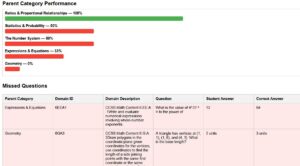
What the High School Number & Quantity Practice Test Results Include
Results provide:
- Overall performance summary
- Identification of strengths
- Clear breakdown of skill gaps
- Domain‑level performance analysis
- Detailed explanations for missed questions
Each question is tied to a specific skill, making it easy to identify areas for improvement.
5 Key Assessment Skill Insights
1. Real Number System Mastery
Evaluates understanding of rational, irrational, integer, and real number classifications.
2. Quantitative Reasoning
Measures how well students interpret quantities, units, and real‑world relationships.
3. Complex Numbers
Assesses operations with complex numbers, including addition, subtraction, multiplication, and magnitude.
4. Vectors & Magnitudes
Evaluates vector operations, direction, and magnitude in real‑world contexts.
5. Units & Measurement
Determines how well students convert units, interpret rates, and use dimensional analysis.
Why the High School Number & Quantity Practice Test Matters
Number & Quantity skills support success in:
- Algebra I & II
- Geometry
- Precalculus
- Calculus
- Physics
- Engineering
- Data science
- STEM pathways
Key Benefits
- Early identification of learning gaps
- Stronger conceptual understanding
- Increased confidence
- Guided instruction and targeted support
Who This High School Number & Quantity Practice Test Is For
This assessment is ideal for:
- Parents monitoring academic progress
- Teachers guiding classroom instruction
- Homeschool families tracking development
- Tutors providing targeted support
- Students preparing for high‑school placement or readiness exams
Using High School Number & Quantity Practice Test Results to Improve Learning
Results help you:
- Target weak areas
- Reinforce strengths
- Use focused practice strategies
- Support steady academic growth
This leads to more efficient and effective learning.
Track Progress Over Time
Regular testing helps identify:
- Growth patterns
- Persistent challenges
- Instructional needs
- Readiness for advanced concepts
What Makes This High School Number & Quantity Practice Test Different
This assessment is designed for accuracy and usability:
- Covers essential Number & Quantity domains
- Provides clear and detailed results
- Offers instant feedback
- Focuses on conceptual understanding
- Supports individualized learning
Sample High School Number & Quantity Practice Test Questions (With Answers & Explanations)
Question 1 — Real Number Classification
Which number is irrational?
A. 4
B. 3/5
C. √7
D. −12
Correct Answer: C. √7
Explanation: √7 cannot be expressed as a fraction.
Question 2 — Rational vs. Irrational
Which number is rational?
A. π
B. √2
C. 0.333…
D. √5
Correct Answer: C. 0.333…
Explanation: Repeating decimals are rational.
Question 3 — Complex Numbers
What is (3 + 2i) + (4 − 5i)?
A. 7 − 3i
B. 1 + 7i
C. 7 + 7i
D. −1 − 3i
Correct Answer: A. 7 − 3i
Explanation: Add real parts and imaginary parts separately.
Question 4 — Vector Magnitude
What is the magnitude of vector ⟨6, 8⟩?
A. 10
B. 12
C. 14
D. 20
Correct Answer: A. 10
Explanation: √(6² + 8²) = √100 = 10.
Question 5 — Units & Rates
A car travels 180 miles in 3 hours. What is its speed?
A. 30 mph
B. 45 mph
C. 60 mph
D. 90 mph
Correct Answer: C. 60 mph
Explanation: Speed = distance ÷ time.
Question 6 — Complex Multiplication
What is i²?
A. 1
B. −1
C. i
D. −i
Correct Answer: B. −1
Explanation: By definition, i² = −1.
Question 7 — Quantitative Reasoning
A tank fills at 12 gallons per minute. How much water after 15 minutes?
A. 120 gallons
B. 150 gallons
C. 180 gallons
D. 200 gallons
Correct Answer: C. 180 gallons
Explanation: Multiply rate × time.
Question 8 — Real Number Properties
Which property is shown: a(b + c) = ab + ac?
A. Commutative
B. Associative
C. Distributive
D. Identity
Correct Answer: C. Distributive
Question 9 — Vector Addition
⟨3, 4⟩ + ⟨1, −2⟩ = ?
A. ⟨4, 2⟩
B. ⟨2, 6⟩
C. ⟨4, −6⟩
D. ⟨3, 2⟩
Correct Answer: A. ⟨4, 2⟩
Question 10 — Real‑World Quantities
A phone battery decreases by 12% per hour. What type of model is this?
A. Linear
B. Quadratic
C. Exponential decay
D. Constant
Correct Answer: C. Exponential decay
Helpful External Math Resources
Khan Academy — Number & Quantity Lessons https://www.khanacademy.org/math
NCTM — Quantitative Reasoning Resources https://www.nctm.org
Math Is Fun — Number System Tutorials https://www.mathsisfun.com
Desmos — Graphing & Modeling Tools https://www.desmos.com
IXL Math — Number & Quantity Skills https://www.ixl.com/math
Start Your High School Number & Quantity Practice Test Today
If you want a clear understanding of student progress, a High School Number & Quantity Practice Test provides the insights you need. With diagnostic assessment and instant results, you can confidently support learning and improvement.
Explore More: Back to K–12 Math Practice Tests (Free & Diagnostic)