
Login | Go To Assessment | Back To Home
Modeling Math Practice Test
A High School Modeling Math Practice Test evaluates how well students use mathematics to represent, analyze, and solve real‑world problems. Modeling is the bridge between abstract math and practical application, making it essential for success in Algebra, Geometry, Algebra II, Precalculus, Statistics, and STEM pathways.
Unlike worksheets or basic word‑problem sets, a High School Modeling Practice Test measures a student’s ability to choose appropriate models, interpret results, and justify reasoning. This ensures results reflect true readiness for advanced math and real‑world problem‑solving.
What Is a High School Modeling Practice Test?
A High School Modeling Practice Test is a diagnostic tool designed to evaluate how effectively students apply mathematical concepts to real‑world scenarios. Students work with equations, graphs, functions, statistics, geometry, and data to build and analyze models.
Modeling is not a separate domain—it integrates skills across all areas of high‑school mathematics.
Skills Assessed in the High School Modeling Practice Test
- Creating and interpreting mathematical models
- Using functions to represent real‑world relationships
- Building linear, quadratic, exponential, and piecewise models
- Using geometry to model physical objects and structures
- Statistical modeling and data interpretation
- Choosing appropriate tools (graphs, tables, equations)
- Evaluating model accuracy and limitations
- Communicating mathematical reasoning
Each question measures conceptual understanding and the ability to apply math meaningfully.
How the High School Modeling Practice Test Works
1. Choose the Modeling Assessment
2. Complete the Test at Your Own Pace
Students can work without time pressure, ensuring accurate results.
3. Receive Instant Results
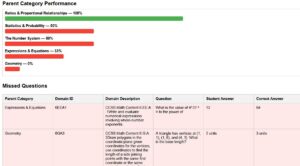
A detailed diagnostic report is available immediately after completion.
What the High School Modeling Practice Test Results Include
Results provide:
- Overall performance summary
- Identification of strengths
- Clear breakdown of skill gaps
- Domain‑level performance analysis
- Detailed explanations for missed questions
Each question is tied to a specific modeling skill, making it easy to identify areas for improvement.
5 Key Assessment Skill Insights
The High School Modeling Practice Test highlights the most important aspects of student learning:
1. Representing Real‑World Situations
Evaluates how well students convert real‑world contexts into equations, graphs, diagrams, or functions.
2. Selecting Appropriate Models
Measures the ability to choose between linear, quadratic, exponential, geometric, or statistical models.
3. Interpreting and Analyzing Models
Assesses how students interpret parameters, constraints, and results within context.
4. Refining and Validating Models
Evaluates whether students can adjust models based on new information or limitations.
5. Communicating Mathematical Reasoning
Determines how clearly students explain their modeling choices and conclusions.
Why the High School Modeling Practice Test Matters
Modeling is the foundation of applied mathematics. Students who master modeling are better prepared for:
- Algebra II
- Precalculus
- Calculus
- Statistics
- Physics
- Engineering
- Data science
- Real‑world problem‑solving
Key Benefits
- Early identification of learning gaps
- Stronger conceptual understanding
- Increased confidence
- Guided instruction and targeted support
Who This High School Modeling Practice Test Is For
This assessment is ideal for:
- Parents monitoring academic progress
- Teachers guiding classroom instruction
- Homeschool families tracking development
- Tutors providing targeted support
- Students preparing for high‑school placement or readiness exams
Using High School Modeling Practice Test Results to Improve Learning
Instead of reviewing all topics equally, results help you:
- Target weak areas
- Reinforce strengths
- Use focused practice strategies
- Support steady academic growth
This leads to more efficient and effective learning.
Track Progress Over Time
Regular testing helps identify:
- Growth patterns
- Persistent challenges
- Instructional needs
- Readiness for advanced concepts
This supports long‑term academic success.
What Makes This High School Modeling Practice Test Different
This assessment is designed for accuracy and usability:
- Covers essential Modeling domains
- Provides clear and detailed results
- Offers instant feedback
- Focuses on conceptual understanding
- Supports individualized learning
Sample High School Modeling Practice Test Questions (With Answers & Explanations)
Question 1 — Linear Modeling
A gym charges a $25 membership fee plus $15 per month. Which function models the total cost C after m months?
A. C = 15m
B. C = 25m
C. C = 25 + 15m
D. C = 15 + 25m
Correct Answer: C. C = 25 + 15m
Explanation: Fixed fee + monthly rate.
Question 2 — Quadratic Modeling
A ball is thrown upward with height modeled by h(t) = −5t² + 20t + 3. What is the maximum height?
A. 3
B. 13
C. 23
D. 25
Correct Answer: C. 23
Explanation: Vertex occurs at t = −b/(2a) = 2; plug in t = 2.
Question 3 — Exponential Modeling
A population grows by 8% each year. Which model represents the population P after t years if the initial population is 500?
A. P = 500(1.08)ᵗ
B. P = 500(0.92)ᵗ
C. P = 500 + 0.08t
D. P = 500t
Correct Answer: A. P = 500(1.08)ᵗ
Explanation: Growth rate > 1.
Question 4 — Piecewise Modeling
A taxi charges $3 for the first mile and $2 for each additional mile. Which model represents the cost C for m miles?
A. C = 3m
B. C = 2m
C. C = 3 + 2(m − 1)
D. C = 3m + 2
Correct Answer: C. C = 3 + 2(m − 1)
Explanation: First mile has a different rate.
Question 5 — Statistical Modeling
A scatterplot shows a strong positive linear trend. Which model is most appropriate?
A. Quadratic
B. Linear
C. Exponential decay
D. No model
Correct Answer: B. Linear
Explanation: Strong positive linear trend → linear model.
Question 6 — Geometry Modeling
A cylindrical water tank has radius 4 ft and height 10 ft. Which expression models its volume?
A. 40π
B. 80π
C. 160π
D. 320π
Correct Answer: C. 160π
Explanation: V = πr²h = π(16)(10).
Question 7 — Interpreting Parameters
In the model C = 12.5h, what does 12.5 represent?
A. Total cost
B. Number of hours
C. Cost per hour
D. A fixed fee
Correct Answer: C. Cost per hour
Explanation: Coefficient = rate.
Question 8 — Refining Models
A model predicts 200 customers, but actual data shows 260. What should be done?
A. Keep the model
B. Adjust the model
C. Delete the data
D. Ignore the difference
Correct Answer: B. Adjust the model
Explanation: Models must reflect real data.
Question 9 — Choosing a Model
A ball bounces to 60% of its previous height each time. Which model applies?
A. Linear
B. Quadratic
C. Exponential decay
D. Piecewise
Correct Answer: C. Exponential decay
Explanation: Repeated percent decrease.
Question 10 — Interpreting Graphs
A graph shows revenue increasing quickly at first, then leveling off. Which model fits best?
A. Linear
B. Exponential growth
C. Logistic
D. Quadratic
Correct Answer: C. Logistic
Explanation: Logistic models growth with a maximum limit.
Helpful External Math Resources
Khan Academy — Modeling & Applications https://www.khanacademy.org/math
NCTM — Mathematical Modeling Resources https://www.nctm.org
Desmos — Modeling Activities & Graphing Tools https://www.desmos.com
Math Is Fun — Real‑World Math Applications https://www.mathsisfun.com
IXL Math — Modeling Skills (Free Limited Access) https://www.ixl.com/math
Start Your High School Modeling Practice Test Today
If you want a clear understanding of student progress, a High School Modeling Practice Test provides the insights you need. With diagnostic assessment and instant results, you can confidently support learning and improvement.
Explore More: Back to K–12 Math Practice Tests (Free & Diagnostic)