
Login | Go To Assessment | Back To Home
1st Grade Math Test: 5 Assessment Skill Insights
A 1st Grade Math Test provides a clear diagnostic picture of early math development, helping parents and educators understand how well a student is progressing beyond foundational Kindergarten skills. Built around widely recognized benchmarks such as the Common Core State Standards Initiative, this assessment measures true understanding—not just memorization—during a critical stage of academic growth.
Unlike simple worksheets or repetitive drills, a 1st grade math test evaluates how students think, reason, and apply math concepts in real situations. This ensures that results reflect actual ability and readiness for continued learning.
What Is a 1st Grade Math Practice Test?
A 1st Grade Math Test is a diagnostic tool designed to measure student progress in early elementary math. At this stage, students begin applying math skills in more structured and meaningful ways.
The test focuses on core areas such as:
- Addition and subtraction within 20
- Understanding place value (tens and ones)
- Comparing numbers and quantities
- Solving word problems
- Recognizing patterns and relationships
- Basic geometry (shapes and attributes)
Each question is designed to evaluate conceptual understanding and problem‑solving ability appropriate for first‑grade learners.
For a full breakdown of grade‑level expectations, refer to the official standards: 👉 https://www.thecorestandards.org/Math/Content/1/
How the 1st Grade Math Practice Test Works
The 1st Grade Math Test is designed to be flexible, accessible, and easy to use.
1. Choose the 1st Grade Assessment
Select the appropriate level based on student learning goals. 👉 Go To Assessment
2. Complete the Test at a Comfortable Pace
There are no strict time limits. Students can work at their own speed to ensure accurate results.
3. Receive Instant Results
Once completed, results are generated immediately, allowing for quick review and action.
What the 1st Grade Math Practice Test Results Include
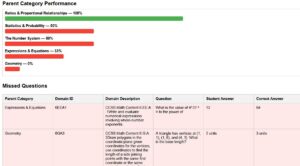
A 1st Grade Math Test provides more than a simple score. It delivers detailed insights into student performance.
Results include:
- Overall performance summary
- Identification of strengths
- Clear breakdown of skill gaps
- Domain‑level performance analysis
- Standards‑aligned feedback
Each question is connected to a specific skill, making it easy to identify areas that need improvement.
5 Key Assessment Skill Insights
The 1st Grade Math Test highlights the most important aspects of student learning:
1. Addition and Subtraction Skills
Evaluates how well students solve basic arithmetic problems and understand number relationships.
2. Place Value Understanding
Measures understanding of tens and ones, a key concept for future math success.
3. Problem‑Solving Ability
Assesses how students approach and solve word problems using reasoning and context clues.
4. Number Comparisons and Ordering
Evaluates the ability to compare numbers and understand numerical relationships.
5. Readiness for 2nd Grade Math
Determines whether the student is prepared for the next level of learning.
Sample 1st Grade Math Test Questions (With Answers & Explanations)
Below are example questions modeled after the skills assessed in the full diagnostic test.
Question 1: Addition Within 20
What is 8 + 7?
A. 12
B. 14
C. 15
D. 16
Correct Answer: C. 15
Explanation: Students should be able to add within 20 using strategies such as counting on or making a ten (8 + 7 = 15).
Question 2: Subtraction Within 20
What is 13 − 5?
A. 6
B. 7
C. 8
D. 9
Correct Answer: C. 8
Explanation: Students subtract within 20 by counting back or using known facts (13 − 5 = 8).
Question 3: Place Value
Which number has 3 tens and 4 ones?
A. 34
B. 43
C. 30
D. 14
Correct Answer: A. 34
Explanation: 3 tens = 30, 4 ones = 4 → 30 + 4 = 34.
Question 4: Comparing Numbers
Which is true?
A. 12 > 15
B. 9 < 7
C. 18 > 14
D. 10 = 12
Correct Answer: C. 18 > 14
Explanation: Students compare two‑digit numbers using place value understanding.
Question 5: Word Problem
Liam has 6 apples. He gets 5 more. How many apples does he have now?
A. 9
B. 10
C. 11
D. 12
Correct Answer: C. 11
Explanation: Students solve simple addition word problems (6 + 5 = 11).
Why the 1st Grade Math Practice Test Matters
First grade is a critical transition point in math development. A 1st Grade Math Test helps ensure students are building the skills needed for long‑term success.
Key Benefits
- Early identification of learning gaps
- Stronger skill development
- Confidence building
- Guided instruction
- Clear progress tracking
Who Should Use the 1st Grade Math Practice Test
The 1st Grade Math Test is ideal for:
- Parents monitoring academic progress
- Teachers guiding instruction
- Homeschool families tracking development
- Tutors providing targeted support
Because learning pace varies, accurate assessment is essential.
Using Results to Improve Learning
The insights from a 1st Grade Math Test allow for targeted improvement.
Parents and educators can:
- Focus on specific weak areas
- Reinforce mastered skills
- Use targeted practice strategies
- Support gradual learning progress
This approach leads to faster and more effective improvement.
Track Progress Over Time
Taking a 1st Grade Math Test regularly helps track growth and identify trends.
Benefits include:
- Monitoring improvement across skills
- Identifying consistent challenges
- Adjusting teaching strategies
- Supporting long‑term academic success
What Makes This Assessment Different?
This assessment is designed for clarity, accuracy, and usability.
- Covers essential 1st grade math domains
- Provides clear and detailed results
- Offers instant feedback
- Focuses on conceptual understanding
- Supports individualized learning
Start Your 1st Grade Math Test Today
If you want a clear understanding of math progress, a 1st Grade Math Test provides the insights you need. With diagnostic assessment and instant results, you can confidently support student learning.